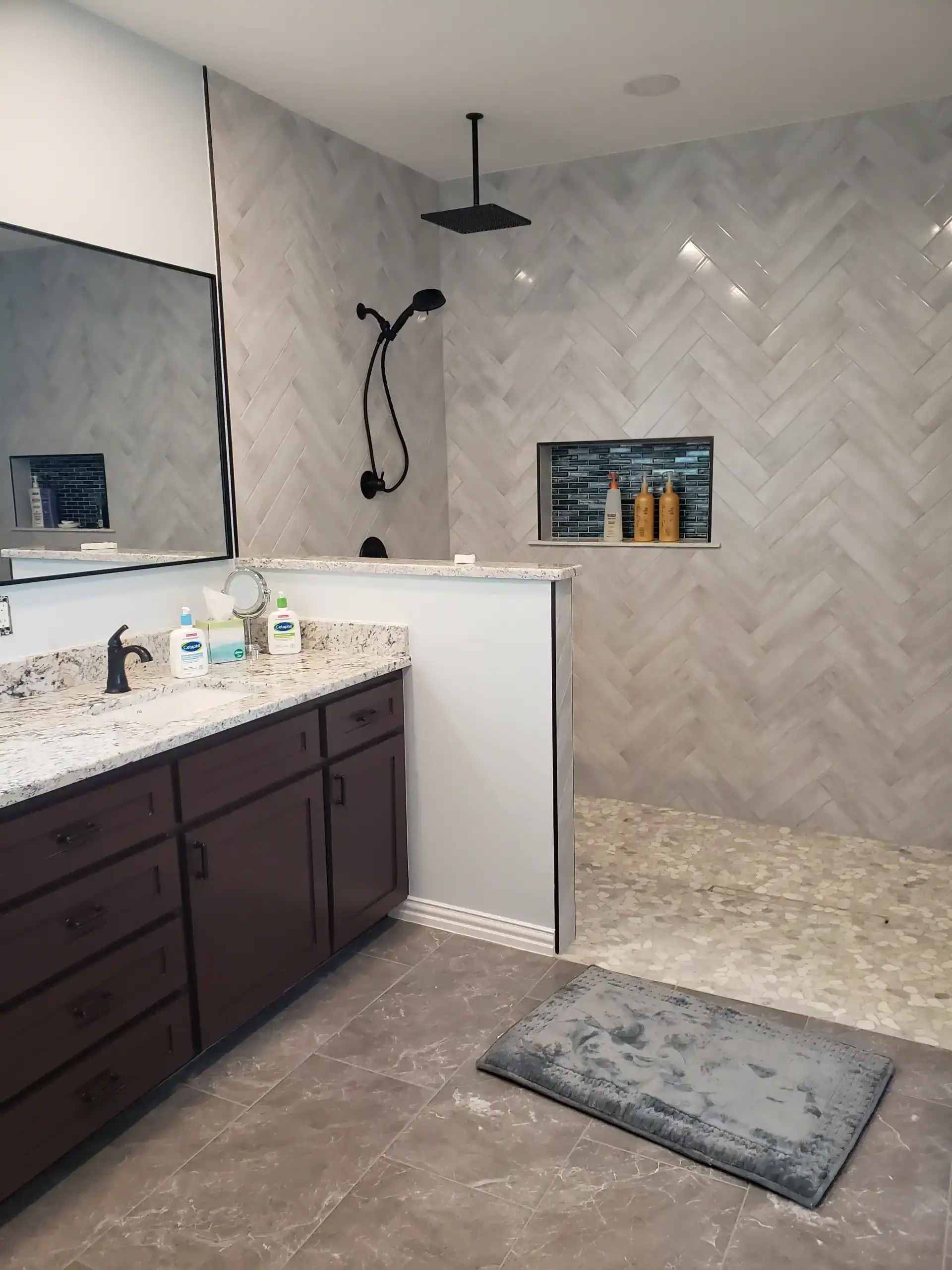

Summary:
You’ve decided to convert your tub to a shower. You’ve called a few companies, maybe gotten a couple of quotes back, and now you’re staring at numbers that don’t seem to have much in common. One is half the price of another. One is a paragraph long. One lists items you didn’t even know were part of the job.
Here’s the thing — the estimate is where the project either gets set up for success or quietly set up for problems. Knowing what should be in it, and what’s suspiciously missing, is the most useful thing you can do before you commit to anyone.
Cost to Replace Tub With Shower: What the Numbers Actually Mean
Most tub-to-shower conversions land somewhere between $2,000 and $12,000, with the majority of standard projects falling in the $6,000 to $11,500 range. That’s a wide window, and it’s not arbitrary — it reflects how much the scope of this project can vary from one home to the next.
Labor alone accounts for 40% to 60% of the total cost on most conversions. Plumbing modifications, when a licensed plumber is involved, run $45 to $200 per hour depending on what needs to move and how far. None of that includes the tile, the glass enclosure, the waterproofing membrane, or what happens if there’s damage behind the wall once the tub comes out.
The number on an estimate only tells you something useful if you know what it covers. A quote that looks low on paper can end up being the most expensive choice you made.
Cost to Replace Bathtub With Shower: What Should Be Listed Line by Line
A complete, honest estimate for a tub-to-shower conversion should account for every phase of the work — not just the parts that are easy to price. When you’re reviewing what we’ve put in front of you, here’s what should be there.
Demolition and haul-away should be explicitly listed. Removing a tub, tearing out the surround, and disposing of the debris is real labor with real cost. If it’s not on the estimate, ask where it’s accounted for.
Plumbing modifications are almost always required. The drain location changes. The valve height may need to adjust. If you’re adding a handheld or dual showerhead, that’s additional work. A legitimate estimate names these items rather than lumping them into a vague “installation” line.
Waterproofing is where a lot of cheap conversions cut corners — and where homeowners end up with mold inside their walls two years later. Proper waterproofing means a moisture barrier membrane behind the tile, cement backer board on the walls (not standard drywall), and proper slope on the shower floor toward the drain. These aren’t optional. They’re what separates a shower that holds up from one that causes structural damage.
The glass enclosure is frequently excluded from low-ball quotes. Frameless glass doors can add $500 to $2,000 or more to the project cost. If the estimate doesn’t mention a door or enclosure, that number is coming back to you later.
Permits should be listed. In Tarrant County and across the DFW area, plumbing modifications require a permit from the relevant municipality — whether that’s Fort Worth, Arlington, Mansfield, or elsewhere. Unpermitted work creates real problems at resale and can affect your homeowner’s insurance. If a company isn’t mentioning permits, that’s worth asking about directly.
Finally, a trustworthy estimate includes a contingency allowance — typically 10% to 15% — for unforeseen conditions. Mold behind the surround, a rotted subfloor, aging pipes that need to be brought up to code: these discoveries are common in older homes, and a contractor who pretends they never happen is either inexperienced or not being straight with you.
What a Low Estimate Is Usually Leaving Out
A quote that comes in significantly under the others isn’t always a deal. More often, it’s a sign that something is missing — and missing items have a way of reappearing as change orders once the work is already underway and you have less leverage.
The most commonly omitted items are permits, waterproofing, the glass door or enclosure, subfloor repair allowance, and debris removal. Each of these is a real cost. When they’re not in the original estimate, they don’t disappear — they just show up later, after you’ve already committed.
Remote quotes are another thing to be cautious about. A company that gives you a firm number based on photos or a phone call hasn’t seen what’s behind your walls. In Tarrant County specifically, homes built in the 1970s through the 1990s — a large portion of the local housing stock — often have aging plumbing, original tile set on standard drywall, and years of slow water infiltration that only shows up once demolition starts. An on-site assessment before quoting isn’t just good practice; it’s the only way to give you a number that actually means something.
The other thing worth asking any company you’re considering: is the crew that shows up your crew? Some contractors in the DFW bath remodeling market take the job and hand it to a subcontractor you’ve never met, who may or may not be licensed. That’s not a hypothetical — it’s a documented pattern that’s burned a lot of homeowners. Knowing whether you’re hiring the company or the company’s vendor is a reasonable question, and a legitimate contractor will answer it directly.
What to Look for When Comparing Tub to Shower Conversion Companies
Once you understand what should be in an estimate, comparing companies gets easier. You’re no longer just looking at the bottom line — you’re looking at what each company is actually committing to.
The clearest trust signals aren’t the ones companies advertise most loudly. They’re the specifics: a written, fixed-price estimate with no change-order language buried in the fine print; confirmation that permits will be pulled; a named warranty covering both materials and workmanship; and a straight answer about who’s physically doing the work.
Years in business matters too — not as a vanity metric, but because a company that’s been operating in the same local market for decades has a track record you can actually verify.
Questions Tarrant County Homeowners Should Ask Before Signing
There are a few questions that tend to separate contractors who are confident in their work from ones who aren’t — and the answers tell you a lot before the project even starts.
Ask whether the estimate is fixed-price and in writing. This matters more than almost anything else. A written estimate that commits to a final price — unless you change the scope — protects you from the change order spiral that catches a lot of homeowners off guard. If a company hedges on this, that’s information worth having.
Ask who pulls the permits. In Tarrant County, a tub-to-shower conversion that involves plumbing modifications — which is essentially all of them — requires a permit from your city’s building department. Fort Worth, Arlington, and other municipalities each have their own process. A contractor who handles this for you, as part of the project, is one less thing you have to manage. A contractor who suggests skipping it is one you should think twice about.
Ask about the waterproofing approach specifically. What membrane do they use? What goes on the walls behind the tile? What’s the slope of the shower floor? If the answer is vague, that’s a gap worth pressing on. Waterproofing failures are the most common cause of long-term damage from shower conversions — and they’re almost always invisible until it’s too late.
Ask whether you’ll see a design before demolition starts. For a project like this, being able to visualize the finished result — tile layout, fixtures, overall look — before anything is torn out is genuinely useful. It eliminates the guesswork and gives you confidence in the choices you’re making, rather than hoping it comes together the way you pictured it.
And ask for local references. Not a general testimonial page — actual Tarrant County homeowners who’ve had similar work done and are willing to talk about it. A company that’s been operating in this area for decades should have no trouble with that request.
Common Questions About Shower Upgrades in Tarrant County
One question that comes up often is whether removing a tub hurts resale value. The short answer is: it depends on the home. If you have more than one bathroom, converting a secondary bathroom tub to a shower typically has minimal impact on resale — and in many cases, a well-executed shower upgrade actually increases appeal to buyers who prefer them. The general guidance is to keep at least one tub in the home, particularly if the home is likely to appeal to families. Beyond that, the quality of the conversion matters far more than the presence of a tub.
Another common question is about timeline. How long will your bathroom be out of commission? For a standard tub-to-shower conversion — demo, plumbing, waterproofing, tile, and enclosure — most projects run several days to a couple of weeks depending on scope and material lead times. One-day conversions exist, but they’re typically prefabricated acrylic liner installs that go over existing surfaces rather than replacing them. They’re faster because they’re doing less — and they don’t address what’s behind the walls. If there’s moisture damage or mold back there, a liner conversion covers it rather than fixing it.
A question specific to Tarrant County: does the DFW water supply affect the longevity of a shower conversion? Yes, meaningfully. The DFW area is known for hard water — high mineral content that accelerates calcium buildup on tile and fixtures and degrades grout and caulk faster than in softer-water regions. Choosing the right grout, the right sealant, and the right tile surface for this environment isn’t optional if you want the conversion to hold up. It’s one of the reasons material selection in North Texas isn’t a one-size-fits-all decision, and why working with a contractor who knows this market specifically — rather than a national brand applying a standardized product — tends to produce better long-term results.
Finding a Tub to Shower Conversion Company You Can Actually Trust
The estimate is a document, but it’s also a signal. A contractor who gives you a detailed, written, fixed-price estimate — one that covers demo, plumbing, waterproofing, permits, materials, and a contingency — is showing you how they operate before the project starts. A contractor who hands you a one-page number with no line items is showing you the same thing.
You’re not just hiring for price. You’re hiring for accountability, local knowledge, and the confidence that the person who shows up knows what they’re doing and stands behind it in writing.
If you’re in Tarrant County and you want a straight conversation about what your specific project would actually involve, we’ve been doing this work in this area since 1990. Reach out and ask for an on-site estimate — it’s the only kind worth comparing.