Hardscaping Services vs. Landscaping: Which Wins for ROI in Tarrant County?

Trying to decide between hardscaping and landscaping for your Tarrant County backyard? Here's what the ROI data actually says — and what matters most in North Texas.

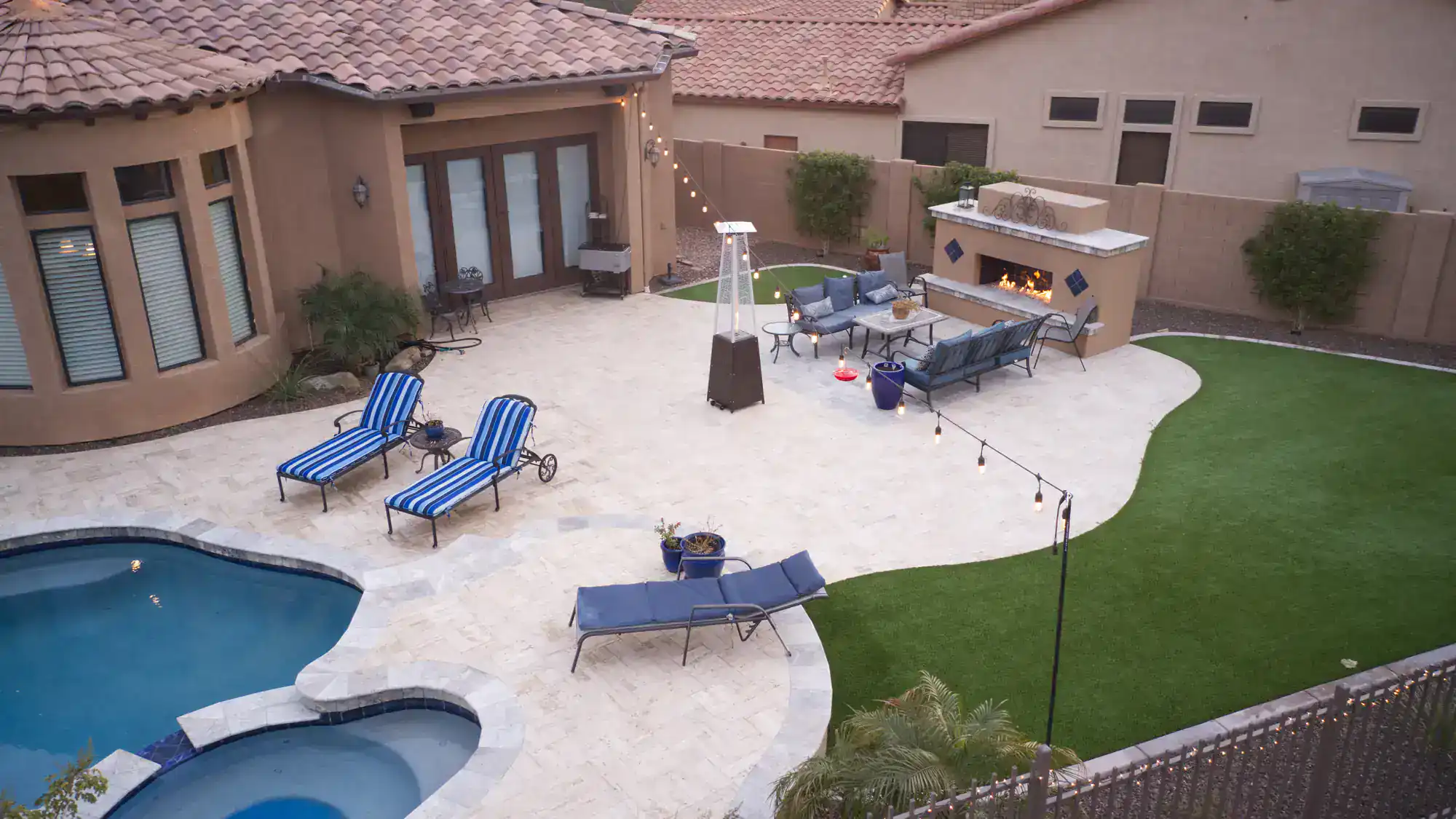
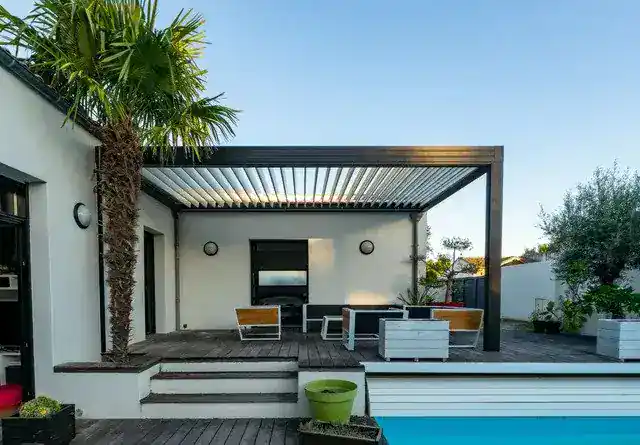
Transform your backyard into a luxurious oasis with a swimming pool, lounge chairs, fire pit patio, outdoor kitchen, and artificial grass—expertly crafted by a trusted Home Remodeling Contractor in Tarrant County, TX.

Summary:

If you’re a homeowner in Tarrant County weighing outdoor improvements, the hardscaping vs. landscaping debate is worth getting right before you spend a dollar. The answer isn’t as simple as one being better than the other — it depends on your goals, your soil, your climate, and how long you plan to stay in your home. This post breaks down the real return on investment for both options, what makes Tarrant County a unique market for outdoor projects, and how to make a decision you won’t regret five years from now.
Table of contents

You’ve got a backyard that isn’t doing much for you. Maybe it’s mostly grass that bakes into straw every July, or a plain concrete slab that’s starting to crack along the edges. Either way, you’re thinking about putting real money into it — and you want to know it’s going to be worth it.

That’s a fair question, and it deserves a straight answer. The hardscaping vs. landscaping debate gets oversimplified a lot. The truth is both have a place, but in Tarrant County — with its brutal summers, expansive clay soil, and active real estate scene — they don’t perform equally. Let’s get into what the numbers actually look like and what makes sense for your home.

What Hardscaping Services Actually Include (and How They Differ from Landscaping)

Landscaping covers the living elements of your outdoor space — grass, plants, trees, mulch beds, irrigation. It’s organic, it changes with the seasons, and it requires ongoing care to stay looking good. Hardscaping is everything else: concrete patios, covered structures, retaining walls, walkways, driveways, outdoor kitchens, pergolas, and decorative concrete surfaces. It’s the built environment of your yard.

The distinction matters because these two categories perform very differently as investments. Landscaping tends to have lower upfront costs and high visual impact at the point of sale. Hardscaping costs more to install but delivers structural, functional value that holds up over decades — and doesn’t need to be watered, mowed, or replanted.

How Does Hardscaping ROI Compare to Landscaping ROI?

The numbers here depend on how you measure return, and that’s where a lot of homeowners get confused. Landscaping can deliver over 100% ROI on project cost at resale — meaning a $5,000 planting and sod project might add $5,000 or more to your home’s perceived value when it’s freshly done and looking great. Some estimates put a well-maintained lawn’s ROI as high as 217%. Those are real numbers, and they’re not wrong.

But here’s what those figures don’t account for: the ongoing cost to maintain that return. Grass in Tarrant County needs consistent watering — which gets expensive fast, especially during drought years when municipalities implement outdoor watering restrictions. Plants die, mulch breaks down, sod thins out. You’re not making a one-time investment. You’re subscribing to a maintenance cycle that costs money every single season.

Hardscaping ROI on project cost typically runs 50–70% on average, with well-executed outdoor living spaces reaching up to 95% return. That sounds lower than landscaping’s headline number — until you factor in that a properly installed concrete patio or covered structure lasts 20 to 30 years with minimal upkeep. No watering. No replanting. No seasonal replacement costs eating into your net return year after year.

Real estate agents in the Tarrant County market consistently note that hardscaping additions — covered patios, decorative concrete, outdoor kitchens — can increase a home’s value by 15 to 20%. In a market where home values have climbed steadily over the past decade, that’s a meaningful number. A $15,000 covered patio investment isn’t just a lifestyle upgrade. In an active buyer’s market, it’s a line item that shows up in your listing price.

The honest answer is that hardscaping and landscaping aren’t really competing — they’re complementary. But if you’re prioritizing long-term financial return with minimal ongoing cost, hardscaping wins the durability argument by a wide margin.

Why Tarrant County's Clay Soil Changes the Hardscaping Equation Entirely

Here’s something most generic hardscaping articles won’t tell you: the ground under your Tarrant County home is one of the most demanding surfaces in the country for outdoor concrete work. North Texas sits on highly expansive clay soil — sometimes called black gumbo locally — that swells dramatically when it absorbs water and contracts just as dramatically when it dries out. That constant movement is exactly what causes concrete to crack, shift, and settle prematurely when it isn’t installed correctly.

This isn’t a minor technical footnote. It’s the single biggest variable that separates hardscaping that lasts 25 years from hardscaping that looks rough in three. If a contractor doesn’t conduct soil analysis before the pour, doesn’t install proper drainage infrastructure, and doesn’t use the right reinforcement methods for expansive soil conditions, you will get cracks. It’s not a matter of if — it’s when.

February 2021 made this painfully clear for a lot of Tarrant County homeowners. Winter Storm Uri exposed every weakness in outdoor concrete and structures that hadn’t been installed with local conditions in mind. Improperly sealed surfaces, inadequate base preparation, drainage that couldn’t handle the freeze-thaw cycle — the damage was widespread. Properly installed, sealed concrete fared significantly better.

This is why the contractor you hire matters more in Tarrant County than in almost any other market. The technical requirements here are specific. A crew that works primarily in other climates or doesn’t understand expansive clay soil is going to deliver a different result than one that’s been doing this work in North Texas for decades. When you’re spending $15,000 to $40,000 on an outdoor project, that difference is not something you want to discover after the fact.

What Hardscaping Projects Make the Most Financial Sense in Tarrant County?

Not every hardscaping investment performs equally. The projects that deliver the strongest combination of functional value and resale return in Tarrant County tend to be the ones that directly address what makes this market unique — extreme summer heat, clay soil challenges, and buyers who want usable outdoor space, not just curb appeal.

Covered patios consistently rank among the highest-value outdoor improvements in this region. When temperatures regularly exceed 100°F from June through August, a bare backyard is functionally useless for a significant portion of the year. A covered, hardscaped outdoor living space with proper concrete flooring and shade structure extends your usable square footage in a way that plants and grass simply cannot.

Is Decorative Concrete Worth It, or Should You Go with Natural Stone?

This is one of the most common questions homeowners ask when planning a patio or outdoor living area, and the answer in most cases is that decorative concrete is the smarter financial move — especially in Tarrant County.

Stamped and decorative concrete installed in North Texas runs roughly $8 to $15 per square foot. Natural flagstone or travertine comes in at $15 to $25 per square foot for comparable installation. That’s a 40 to 60% cost difference for a finished surface that, when done well, is visually very similar. Both materials can be sealed, both hold up to Texas heat, and both can be designed to complement the architecture of your home.

Where decorative concrete has a clear advantage is in its adaptability to Tarrant County soil conditions. A skilled installer can engineer the base preparation, reinforcement, and drainage specifically for your site’s soil profile in ways that are harder to achieve with natural stone laid on an unstable substrate. When the ground moves — and in this region, it will move — a properly reinforced concrete surface is more forgiving than individual stone pieces that can shift and separate.

There’s also the maintenance angle. Natural stone requires periodic re-sealing, weed management between joints, and occasional piece replacement when individual stones crack or shift. Decorative concrete, properly sealed at installation and maintained, is largely set-and-forget for years at a time. For homeowners in communities throughout Tarrant County who want a high-end look without the ongoing upkeep, it’s a practical choice that holds up in the long run.

The visual range of modern stamped concrete is also worth noting. Patterns and textures have advanced significantly — you can achieve the look of slate, cobblestone, brick, or natural stone at a fraction of the material cost. For a homeowner trying to maximize the appearance of their outdoor space while keeping the budget rational, decorative concrete is hard to argue against.

Do Permits Matter for Hardscaping Projects in Tarrant County?

Yes — and this is an area where a lot of homeowners get caught off guard, especially with covered structures. Most covered porch and patio construction in Tarrant County requires building permits from the relevant municipality. The specific requirements vary slightly by jurisdiction, but the general rule is: if it has a roof, it needs a permit.

This matters for a few reasons that go beyond just following the rules. Unpermitted work creates real problems when you sell. Buyers’ inspectors flag it, lenders sometimes balk at it, and title companies occasionally require it to be addressed before closing. What seemed like a shortcut at the time of construction becomes a negotiating liability years later — often at the worst possible moment.

There’s also the insurance dimension. If something goes wrong with an unpermitted structure — storm damage, a structural issue, an injury — your homeowner’s insurance may not cover it. The permit process exists to ensure the work meets code, and insurers pay attention to whether it did.

Working with a contractor who pulls permits on every project isn’t just about compliance. It’s about protecting the investment you’re making. When you spend $20,000 on a covered patio addition, you want that improvement to show up as a documented, code-compliant asset when it’s time to sell — not as a red flag in the inspection report. Every project we complete includes proper permits pulled for the relevant Tarrant County jurisdiction, without exception.

The permit question also connects to contractor accountability. When work is subcontracted out without clear responsibility, permit pulling can fall through the cracks. With a single in-house crew and one point of contact managing the project from start to finish, there’s no ambiguity about who’s responsible for making sure the paperwork is in order.

Which Outdoor Investment Is Right for Your Tarrant County Home?

Landscaping has its place — fresh plants and clean lawn edges make a strong first impression and can move a listing quickly. But in Tarrant County, where summers are brutal, clay soil is unforgiving, and buyers are increasingly looking for functional outdoor living space, hardscaping is where the durable, long-term value lives. The upfront cost is higher. The maintenance cost over time is dramatically lower. And the structural improvements you make today will still be performing 20 years from now.

The key is getting the installation right from the start. That means a contractor who understands the soil conditions specific to this area, pulls the proper permits, warranties their work in writing, and gives you a fixed price before the first shovel hits the ground.

If you’re weighing your options for a hardscaping project in Tarrant County and want a clear picture of what’s possible — and what it actually costs — we’ve been doing this work in North Texas for over 30 years. Reach out for a consultation and get a written estimate with no surprises attached.
Share:

Summary:

If you’re a homeowner in Tarrant County weighing outdoor improvements, the hardscaping vs. landscaping debate is worth getting right before you spend a dollar. The answer isn’t as simple as one being better than the other — it depends on your goals, your soil, your climate, and how long you plan to stay in your home. This post breaks down the real return on investment for both options, what makes Tarrant County a unique market for outdoor projects, and how to make a decision you won’t regret five years from now.
Table of contents

You’ve got a backyard that isn’t doing much for you. Maybe it’s mostly grass that bakes into straw every July, or a plain concrete slab that’s starting to crack along the edges. Either way, you’re thinking about putting real money into it — and you want to know it’s going to be worth it.

That’s a fair question, and it deserves a straight answer. The hardscaping vs. landscaping debate gets oversimplified a lot. The truth is both have a place, but in Tarrant County — with its brutal summers, expansive clay soil, and active real estate scene — they don’t perform equally. Let’s get into what the numbers actually look like and what makes sense for your home.

What Hardscaping Services Actually Include (and How They Differ from Landscaping)

Landscaping covers the living elements of your outdoor space — grass, plants, trees, mulch beds, irrigation. It’s organic, it changes with the seasons, and it requires ongoing care to stay looking good. Hardscaping is everything else: concrete patios, covered structures, retaining walls, walkways, driveways, outdoor kitchens, pergolas, and decorative concrete surfaces. It’s the built environment of your yard.

The distinction matters because these two categories perform very differently as investments. Landscaping tends to have lower upfront costs and high visual impact at the point of sale. Hardscaping costs more to install but delivers structural, functional value that holds up over decades — and doesn’t need to be watered, mowed, or replanted.

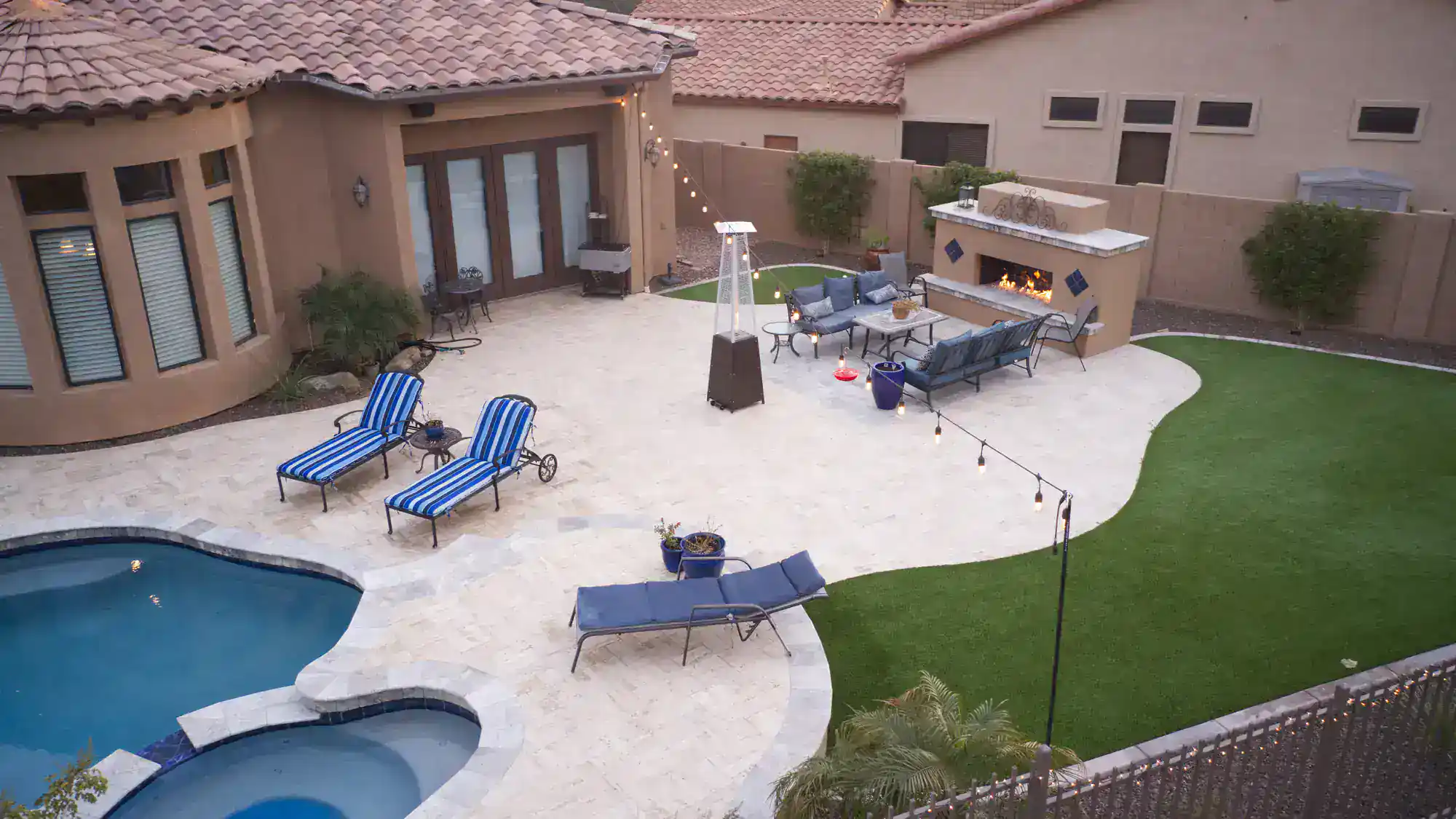
Backyard patio and pool remodel in Tarrant County, Texas with updated outdoor living space

How Does Hardscaping ROI Compare to Landscaping ROI?

The numbers here depend on how you measure return, and that’s where a lot of homeowners get confused. Landscaping can deliver over 100% ROI on project cost at resale — meaning a $5,000 planting and sod project might add $5,000 or more to your home’s perceived value when it’s freshly done and looking great. Some estimates put a well-maintained lawn’s ROI as high as 217%. Those are real numbers, and they’re not wrong.

But here’s what those figures don’t account for: the ongoing cost to maintain that return. Grass in Tarrant County needs consistent watering — which gets expensive fast, especially during drought years when municipalities implement outdoor watering restrictions. Plants die, mulch breaks down, sod thins out. You’re not making a one-time investment. You’re subscribing to a maintenance cycle that costs money every single season.

Hardscaping ROI on project cost typically runs 50–70% on average, with well-executed outdoor living spaces reaching up to 95% return. That sounds lower than landscaping’s headline number — until you factor in that a properly installed concrete patio or covered structure lasts 20 to 30 years with minimal upkeep. No watering. No replanting. No seasonal replacement costs eating into your net return year after year.

Real estate agents in the Tarrant County market consistently note that hardscaping additions — covered patios, decorative concrete, outdoor kitchens — can increase a home’s value by 15 to 20%. In a market where home values have climbed steadily over the past decade, that’s a meaningful number. A $15,000 covered patio investment isn’t just a lifestyle upgrade. In an active buyer’s market, it’s a line item that shows up in your listing price.

The honest answer is that hardscaping and landscaping aren’t really competing — they’re complementary. But if you’re prioritizing long-term financial return with minimal ongoing cost, hardscaping wins the durability argument by a wide margin.

Why Tarrant County's Clay Soil Changes the Hardscaping Equation Entirely

Here’s something most generic hardscaping articles won’t tell you: the ground under your Tarrant County home is one of the most demanding surfaces in the country for outdoor concrete work. North Texas sits on highly expansive clay soil — sometimes called black gumbo locally — that swells dramatically when it absorbs water and contracts just as dramatically when it dries out. That constant movement is exactly what causes concrete to crack, shift, and settle prematurely when it isn’t installed correctly.

This isn’t a minor technical footnote. It’s the single biggest variable that separates hardscaping that lasts 25 years from hardscaping that looks rough in three. If a contractor doesn’t conduct soil analysis before the pour, doesn’t install proper drainage infrastructure, and doesn’t use the right reinforcement methods for expansive soil conditions, you will get cracks. It’s not a matter of if — it’s when.

February 2021 made this painfully clear for a lot of Tarrant County homeowners. Winter Storm Uri exposed every weakness in outdoor concrete and structures that hadn’t been installed with local conditions in mind. Improperly sealed surfaces, inadequate base preparation, drainage that couldn’t handle the freeze-thaw cycle — the damage was widespread. Properly installed, sealed concrete fared significantly better.

This is why the contractor you hire matters more in Tarrant County than in almost any other market. The technical requirements here are specific. A crew that works primarily in other climates or doesn’t understand expansive clay soil is going to deliver a different result than one that’s been doing this work in North Texas for decades. When you’re spending $15,000 to $40,000 on an outdoor project, that difference is not something you want to discover after the fact.

Want live answers?

Connect with a A Plus Home Remodel expert for fast, friendly support.

What Hardscaping Projects Make the Most Financial Sense in Tarrant County?

Not every hardscaping investment performs equally. The projects that deliver the strongest combination of functional value and resale return in Tarrant County tend to be the ones that directly address what makes this market unique — extreme summer heat, clay soil challenges, and buyers who want usable outdoor space, not just curb appeal.

Covered patios consistently rank among the highest-value outdoor improvements in this region. When temperatures regularly exceed 100°F from June through August, a bare backyard is functionally useless for a significant portion of the year. A covered, hardscaped outdoor living space with proper concrete flooring and shade structure extends your usable square footage in a way that plants and grass simply cannot.

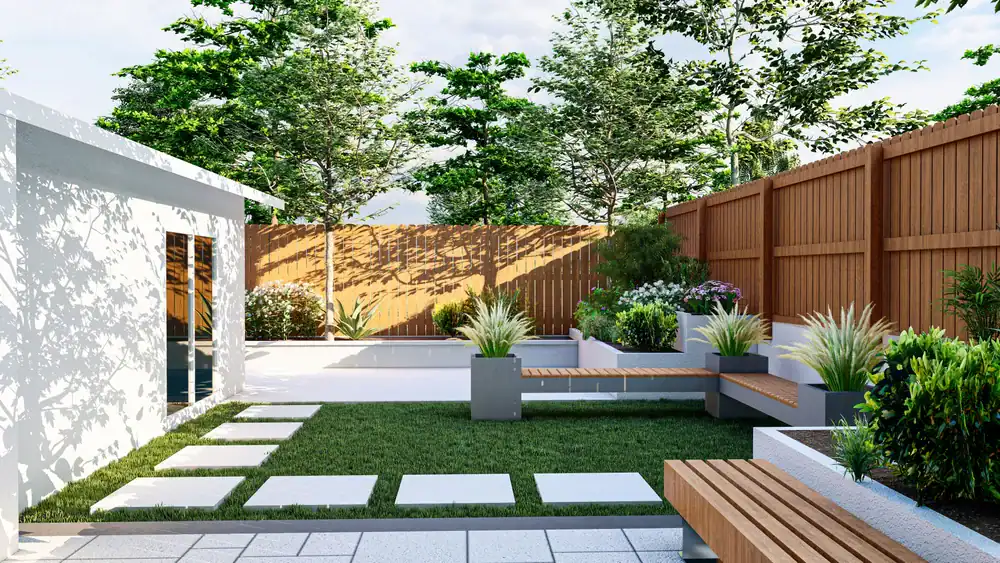
Modern backyard garden with green grass, stepping stones, wooden benches, raised planters with various shrubs, a wooden fence, and tall trees in the background. Sunlight casts shadows across the area.

Is Decorative Concrete Worth It, or Should You Go with Natural Stone?

This is one of the most common questions homeowners ask when planning a patio or outdoor living area, and the answer in most cases is that decorative concrete is the smarter financial move — especially in Tarrant County.

Stamped and decorative concrete installed in North Texas runs roughly $8 to $15 per square foot. Natural flagstone or travertine comes in at $15 to $25 per square foot for comparable installation. That’s a 40 to 60% cost difference for a finished surface that, when done well, is visually very similar. Both materials can be sealed, both hold up to Texas heat, and both can be designed to complement the architecture of your home.

Where decorative concrete has a clear advantage is in its adaptability to Tarrant County soil conditions. A skilled installer can engineer the base preparation, reinforcement, and drainage specifically for your site’s soil profile in ways that are harder to achieve with natural stone laid on an unstable substrate. When the ground moves — and in this region, it will move — a properly reinforced concrete surface is more forgiving than individual stone pieces that can shift and separate.

There’s also the maintenance angle. Natural stone requires periodic re-sealing, weed management between joints, and occasional piece replacement when individual stones crack or shift. Decorative concrete, properly sealed at installation and maintained, is largely set-and-forget for years at a time. For homeowners in communities throughout Tarrant County who want a high-end look without the ongoing upkeep, it’s a practical choice that holds up in the long run.

The visual range of modern stamped concrete is also worth noting. Patterns and textures have advanced significantly — you can achieve the look of slate, cobblestone, brick, or natural stone at a fraction of the material cost. For a homeowner trying to maximize the appearance of their outdoor space while keeping the budget rational, decorative concrete is hard to argue against.

Do Permits Matter for Hardscaping Projects in Tarrant County?

Yes — and this is an area where a lot of homeowners get caught off guard, especially with covered structures. Most covered porch and patio construction in Tarrant County requires building permits from the relevant municipality. The specific requirements vary slightly by jurisdiction, but the general rule is: if it has a roof, it needs a permit.

This matters for a few reasons that go beyond just following the rules. Unpermitted work creates real problems when you sell. Buyers’ inspectors flag it, lenders sometimes balk at it, and title companies occasionally require it to be addressed before closing. What seemed like a shortcut at the time of construction becomes a negotiating liability years later — often at the worst possible moment.

There’s also the insurance dimension. If something goes wrong with an unpermitted structure — storm damage, a structural issue, an injury — your homeowner’s insurance may not cover it. The permit process exists to ensure the work meets code, and insurers pay attention to whether it did.

Working with a contractor who pulls permits on every project isn’t just about compliance. It’s about protecting the investment you’re making. When you spend $20,000 on a covered patio addition, you want that improvement to show up as a documented, code-compliant asset when it’s time to sell — not as a red flag in the inspection report. Every project we complete includes proper permits pulled for the relevant Tarrant County jurisdiction, without exception.

The permit question also connects to contractor accountability. When work is subcontracted out without clear responsibility, permit pulling can fall through the cracks. With a single in-house crew and one point of contact managing the project from start to finish, there’s no ambiguity about who’s responsible for making sure the paperwork is in order.

Which Outdoor Investment Is Right for Your Tarrant County Home?

Landscaping has its place — fresh plants and clean lawn edges make a strong first impression and can move a listing quickly. But in Tarrant County, where summers are brutal, clay soil is unforgiving, and buyers are increasingly looking for functional outdoor living space, hardscaping is where the durable, long-term value lives. The upfront cost is higher. The maintenance cost over time is dramatically lower. And the structural improvements you make today will still be performing 20 years from now.

The key is getting the installation right from the start. That means a contractor who understands the soil conditions specific to this area, pulls the proper permits, warranties their work in writing, and gives you a fixed price before the first shovel hits the ground.

If you’re weighing your options for a hardscaping project in Tarrant County and want a clear picture of what’s possible — and what it actually costs — we’ve been doing this work in North Texas for over 30 years. Reach out for a consultation and get a written estimate with no surprises attached.
Article details:

Share: