Concrete Driveway Cost in Tarrant County: 2026 Pricing

Real 2026 pricing for concrete driveways in Tarrant County — plus what local clay soil means for your installation and how to hire a contractor you can trust.

A Plus Arlington Texas home exterior with clean curb appeal and professional local service branding

Summary:

Concrete driveway costs in Tarrant County vary more than most homeowners expect — and in North Texas, the soil underneath your slab matters just as much as what goes on top of it. This guide breaks down current 2026 pricing, explains what drives costs up or down, and walks you through what separates a driveway that lasts 30 years from one that cracks in five. If you’re trying to budget a new driveway or replace one that’s already failing, this is the page that gives you straight answers — not ballpark guesses.
Table of contents

If your driveway is cracked, sunken, or just embarrassing to look at, you’re probably trying to figure out what it actually costs to fix before you call anyone. That’s smart. Walking into a contractor conversation without a number in your head is how people get overcharged.

This page gives you real 2026 pricing for concrete driveways in Tarrant County, TX — not national averages copy-pasted from a spreadsheet. We’ll also cover why driveways in this part of Texas fail faster than they should, what a proper installation actually includes, and what to look for when you’re comparing contractors. By the end, you’ll know exactly what questions to ask and what answers should concern you.

Local Concrete Contractors in Tarrant County: What You're Actually Paying For

In Fort Worth, Arlington, Mansfield, and across Tarrant County, a standard concrete driveway runs roughly $6 to $10 per square foot for a plain finish — meaning a typical two-car driveway (around 400 to 576 square feet) lands somewhere between $2,400 and $5,760 before any upgrades. Decorative or stamped concrete pushes that range to $12 to $20 per square foot, depending on the pattern and finish you choose.

Those numbers come from local market data, not national averages. A properly reinforced installation built for Tarrant County’s specific soil conditions is going to cost more than a generic estimate, and for good reason.

What you’re paying for isn’t just the concrete. You’re paying for excavation, base preparation, reinforcement, forming, the pour itself, finishing, control joints, sealing, and cleanup. A contractor who quotes you significantly below market rate is cutting something out of that list. The question is which part.

Why Concrete Driveways in North Texas Cost More to Do Right

Here’s something most cost guides won’t tell you: Tarrant County sits on Blackland Prairie clay soil, and that changes everything about how a concrete driveway needs to be built.

Blackland Prairie clay is expansive. When it rains — and North Texas gets wet springs — the soil swells. When summer drought hits and temperatures push past 100°F, that same soil contracts and pulls away from whatever’s sitting on top of it. This expansion and contraction cycle is relentless, and it’s the single biggest reason driveways in this area crack, heave, and fail well before they should.

A concrete driveway that’s built without accounting for this will start showing problems within five to ten years. You’ll see cracks running across the slab, sections that have lifted or dropped, and edges that have started to crumble. Patching those cracks on top of shifting clay is a temporary fix at best. The underlying problem doesn’t go away.

Doing it right means excavating to the correct depth and installing properly compacted base material before a single yard of concrete gets poured. It means using a fiber-reinforced concrete mix — not the cheapest mix available — and placing control joints at the right intervals to direct any cracking that does occur to predetermined locations rather than letting it run wherever it wants. It means applying a quality concrete sealer after the pour to protect against moisture intrusion and surface degradation from the Texas heat.

All of that costs more than a basic pour on a flat lot in a stable-soil market. But in Tarrant County, it’s not optional. It’s the difference between a driveway that lasts 30 to 50 years and one that needs to be replaced in a decade.

We’ve been working in this soil for over 30 years, across Fort Worth, Arlington, Mansfield, Keller, Hurst, Euless, Bedford, and every corner of Tarrant County. The clay soil problem isn’t news to us — it’s something we plan for on every single job.

Concrete Driveway Permits in Tarrant County: What You Need to Know

Permits for concrete driveways in Tarrant County aren’t optional — they’re required, and the rules vary depending on exactly where your property sits.

If your driveway connects to or runs through unincorporated Tarrant County right-of-way, you need a ROW Encroachment Permit from Tarrant County Transportation Services (817-884-1250). If you’re in Fort Worth, Arlington, Mansfield, or any other incorporated city within the county, the city’s own building permit process applies. In some cases — particularly if your driveway connects to a TxDOT-managed road — there’s a separate TxDOT driveway permit requirement on top of that.

This matters for a few reasons. First, unpermitted work can create serious complications when you sell your home. Title companies and buyers’ agents ask about permits, and work done without them can delay or derail a closing. Second, permits trigger inspections, which protect you. An inspector catching a problem before the concrete is poured is far less expensive than discovering it five years later when the slab starts moving.

We pull every permit required for every project, as a standard part of the job — not an add-on, not a conversation you have to initiate. It’s just how the work gets done correctly.

Decorative Concrete Installation: More Options Than Most Homeowners Realize

Plain gray concrete is functional, but it’s not your only option. Stamped, colored, and textured concrete finishes are increasingly popular for driveways in Tarrant County — and the cost difference is smaller than most people expect.

A decorative concrete driveway in the Fort Worth area typically runs $12 to $20 per square foot, compared to $6 to $10 for a standard finish. On a 500-square-foot driveway, that’s a difference of roughly $3,000 to $5,000 — meaningful, but not out of reach for a homeowner in a market where the median home price is $345,000 to $347,000. The curb appeal return on that investment is significant, especially if you’re thinking about selling in the next few years.

Tarrant County’s housing market has been active — home sales were up 8.4% year-over-year as of fall 2025, and inventory sits at around 3.8 months. In that kind of market, first impressions matter. A driveway that looks like it belongs to a well-maintained home commands attention.

What Are Your Options for Decorative Concrete Driveways?

Decorative concrete covers a wide range of finishes, and the right choice depends on your home’s style, your budget, and how much visual impact you want.

Stamped concrete is the most popular option. It’s poured as a standard slab and then imprinted with a pattern before it sets — common patterns include cobblestone, slate, brick, and wood plank. The result looks like a premium material at a fraction of the cost of actual stone or pavers. Stamped concrete can also be colored, either through integral pigment mixed into the concrete itself or through a surface-applied color hardener.

Exposed aggregate is another option that works well in the Texas heat — the surface is finished to reveal the natural stone aggregate within the mix, creating a textured, slip-resistant surface that holds up well under heavy UV exposure. Broom-finished concrete, which creates a lightly textured surface through a simple finishing technique, is the most affordable upgrade from a plain smooth finish and is a popular choice for driveways that need traction without a decorative pattern.

Decorative concrete requires more precision in timing and application than a standard pour. The window for stamping or texturing the surface is narrow — too early and the pattern won’t hold, too late and the concrete has already set. We use certified application techniques on every decorative concrete project, which is also what qualifies the materials for extended manufacturer warranties.

Before any work starts, we use digital design tools to show you what your driveway will look like — the pattern, the color, the dimensions. You approve it before we pour anything. That step alone eliminates a lot of the anxiety that comes with a project this size.

Concrete Installation Services: What a Complete Job Actually Includes

When you get a quote for concrete installation services, it’s worth understanding what a complete job looks like — because not every quote covers the same scope.

A proper driveway installation starts well before the concrete truck arrives. The existing driveway (if there is one) needs to be demolished and hauled away. The ground beneath needs to be excavated to the correct depth — typically four to six inches for a residential driveway, deeper if the household has heavy vehicles like trucks or RVs. The subbase needs to be compacted properly. None of that is glamorous work, but skipping or shortcutting any of it is what leads to a failing slab two years down the road.

The concrete itself should meet a minimum compressive strength of 4,500 PSI for a residential driveway. Fiber reinforcement adds tensile strength that plain concrete lacks, which is especially important in Tarrant County’s clay soil conditions. Rebar may be added for additional structural reinforcement depending on the size and use of the driveway.

Control joints are cut or formed into the slab at regular intervals — typically every 8 to 10 feet — to give the concrete a designated place to crack if it does crack, rather than letting stress fractures run wherever they want. After the pour and finishing, a quality sealer is applied to protect the surface from moisture, staining, and UV degradation.

Curing time matters too. Concrete reaches its full design strength at 28 days. Light foot traffic is generally fine after 7 days, but vehicle traffic should wait the full 28 days. A contractor who tells you to drive on it after 48 hours is not giving you accurate information.

Our estimates are fixed-price and written — your quote is your final number unless you change the scope. No surprise line items at the end, no “we ran into an issue” charges that weren’t disclosed upfront. We also handle all permitting, provide a single point of contact throughout the project, and back the work with a written warranty covering both materials and workmanship. We’ve completed more than 400 projects across Tarrant County over the past 30-plus years, and that track record matters when you’re making a decision this size.

How to Choose the Right Concrete Driveway Company in Tarrant County

The short version: get at least three written estimates, verify that each contractor is licensed and insured, ask specifically about permits, and pay attention to how they explain their process. A contractor who can tell you exactly why they use fiber reinforcement, how they handle base preparation in clay soil, and what the permit requirements are for your specific address is a contractor who knows what they’re doing.

Price matters, but it’s not the whole story. The lowest bid in Tarrant County clay soil is often the most expensive option over a ten-year horizon — because the corners that get cut show up in the slab.

If you’re ready to get a real number for your driveway — not a ballpark, but a fixed-price written estimate based on your actual property — reach out to us. We’re based in Arlington, we serve all of Tarrant County, and we’ve been doing this long enough to know exactly what your driveway is up against.

Share:

Summary:

Concrete driveway costs in Tarrant County vary more than most homeowners expect — and in North Texas, the soil underneath your slab matters just as much as what goes on top of it. This guide breaks down current 2026 pricing, explains what drives costs up or down, and walks you through what separates a driveway that lasts 30 years from one that cracks in five. If you’re trying to budget a new driveway or replace one that’s already failing, this is the page that gives you straight answers — not ballpark guesses.
Table of contents

If your driveway is cracked, sunken, or just embarrassing to look at, you’re probably trying to figure out what it actually costs to fix before you call anyone. That’s smart. Walking into a contractor conversation without a number in your head is how people get overcharged.

This page gives you real 2026 pricing for concrete driveways in Tarrant County, TX — not national averages copy-pasted from a spreadsheet. We’ll also cover why driveways in this part of Texas fail faster than they should, what a proper installation actually includes, and what to look for when you’re comparing contractors. By the end, you’ll know exactly what questions to ask and what answers should concern you.

Local Concrete Contractors in Tarrant County: What You're Actually Paying For

In Fort Worth, Arlington, Mansfield, and across Tarrant County, a standard concrete driveway runs roughly $6 to $10 per square foot for a plain finish — meaning a typical two-car driveway (around 400 to 576 square feet) lands somewhere between $2,400 and $5,760 before any upgrades. Decorative or stamped concrete pushes that range to $12 to $20 per square foot, depending on the pattern and finish you choose.

Those numbers come from local market data, not national averages. A properly reinforced installation built for Tarrant County’s specific soil conditions is going to cost more than a generic estimate, and for good reason.

What you’re paying for isn’t just the concrete. You’re paying for excavation, base preparation, reinforcement, forming, the pour itself, finishing, control joints, sealing, and cleanup. A contractor who quotes you significantly below market rate is cutting something out of that list. The question is which part.

A woman in casual clothes sits on a ladder in an unfinished room, studying architectural blueprints. The walls behind her are partially drywalled, suggesting ongoing renovation or construction work.

Why Concrete Driveways in North Texas Cost More to Do Right

Here’s something most cost guides won’t tell you: Tarrant County sits on Blackland Prairie clay soil, and that changes everything about how a concrete driveway needs to be built.

Blackland Prairie clay is expansive. When it rains — and North Texas gets wet springs — the soil swells. When summer drought hits and temperatures push past 100°F, that same soil contracts and pulls away from whatever’s sitting on top of it. This expansion and contraction cycle is relentless, and it’s the single biggest reason driveways in this area crack, heave, and fail well before they should.

A concrete driveway that’s built without accounting for this will start showing problems within five to ten years. You’ll see cracks running across the slab, sections that have lifted or dropped, and edges that have started to crumble. Patching those cracks on top of shifting clay is a temporary fix at best. The underlying problem doesn’t go away.

Doing it right means excavating to the correct depth and installing properly compacted base material before a single yard of concrete gets poured. It means using a fiber-reinforced concrete mix — not the cheapest mix available — and placing control joints at the right intervals to direct any cracking that does occur to predetermined locations rather than letting it run wherever it wants. It means applying a quality concrete sealer after the pour to protect against moisture intrusion and surface degradation from the Texas heat.

All of that costs more than a basic pour on a flat lot in a stable-soil market. But in Tarrant County, it’s not optional. It’s the difference between a driveway that lasts 30 to 50 years and one that needs to be replaced in a decade.

We’ve been working in this soil for over 30 years, across Fort Worth, Arlington, Mansfield, Keller, Hurst, Euless, Bedford, and every corner of Tarrant County. The clay soil problem isn’t news to us — it’s something we plan for on every single job.

Concrete Driveway Permits in Tarrant County: What You Need to Know

Permits for concrete driveways in Tarrant County aren’t optional — they’re required, and the rules vary depending on exactly where your property sits.

If your driveway connects to or runs through unincorporated Tarrant County right-of-way, you need a ROW Encroachment Permit from Tarrant County Transportation Services (817-884-1250). If you’re in Fort Worth, Arlington, Mansfield, or any other incorporated city within the county, the city’s own building permit process applies. In some cases — particularly if your driveway connects to a TxDOT-managed road — there’s a separate TxDOT driveway permit requirement on top of that.

This matters for a few reasons. First, unpermitted work can create serious complications when you sell your home. Title companies and buyers’ agents ask about permits, and work done without them can delay or derail a closing. Second, permits trigger inspections, which protect you. An inspector catching a problem before the concrete is poured is far less expensive than discovering it five years later when the slab starts moving.

We pull every permit required for every project, as a standard part of the job — not an add-on, not a conversation you have to initiate. It’s just how the work gets done correctly.

Want live answers?

Connect with a A Plus Home Remodel expert for fast, friendly support.

Decorative Concrete Installation: More Options Than Most Homeowners Realize

Plain gray concrete is functional, but it’s not your only option. Stamped, colored, and textured concrete finishes are increasingly popular for driveways in Tarrant County — and the cost difference is smaller than most people expect.

A decorative concrete driveway in the Fort Worth area typically runs $12 to $20 per square foot, compared to $6 to $10 for a standard finish. On a 500-square-foot driveway, that’s a difference of roughly $3,000 to $5,000 — meaningful, but not out of reach for a homeowner in a market where the median home price is $345,000 to $347,000. The curb appeal return on that investment is significant, especially if you’re thinking about selling in the next few years.

Tarrant County’s housing market has been active — home sales were up 8.4% year-over-year as of fall 2025, and inventory sits at around 3.8 months. In that kind of market, first impressions matter. A driveway that looks like it belongs to a well-maintained home commands attention.

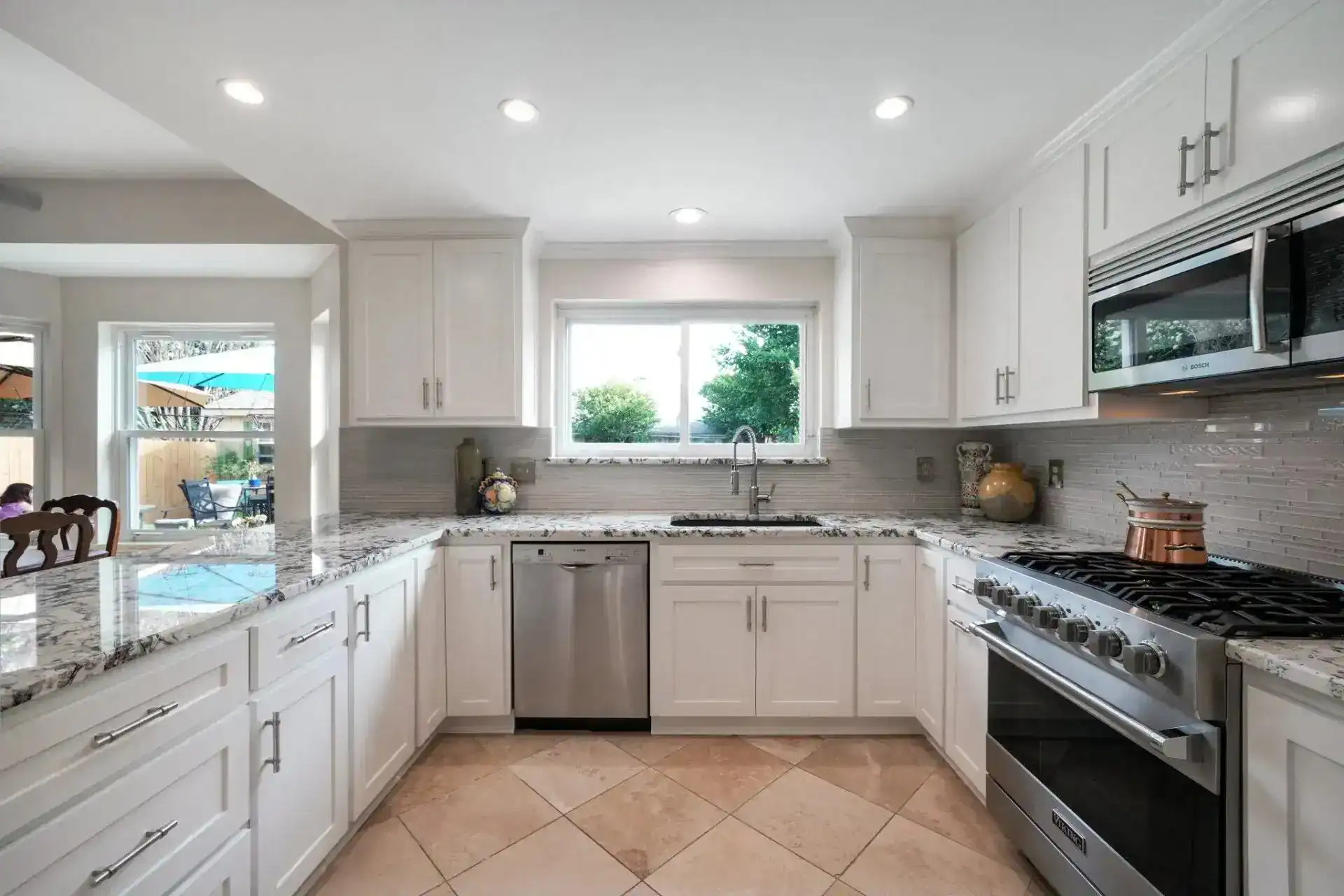
Arlington kitchen remodeling project with updated cabinets, countertops, lighting, and modern home design.

What Are Your Options for Decorative Concrete Driveways?

Decorative concrete covers a wide range of finishes, and the right choice depends on your home’s style, your budget, and how much visual impact you want.

Stamped concrete is the most popular option. It’s poured as a standard slab and then imprinted with a pattern before it sets — common patterns include cobblestone, slate, brick, and wood plank. The result looks like a premium material at a fraction of the cost of actual stone or pavers. Stamped concrete can also be colored, either through integral pigment mixed into the concrete itself or through a surface-applied color hardener.

Exposed aggregate is another option that works well in the Texas heat — the surface is finished to reveal the natural stone aggregate within the mix, creating a textured, slip-resistant surface that holds up well under heavy UV exposure. Broom-finished concrete, which creates a lightly textured surface through a simple finishing technique, is the most affordable upgrade from a plain smooth finish and is a popular choice for driveways that need traction without a decorative pattern.

Decorative concrete requires more precision in timing and application than a standard pour. The window for stamping or texturing the surface is narrow — too early and the pattern won’t hold, too late and the concrete has already set. We use certified application techniques on every decorative concrete project, which is also what qualifies the materials for extended manufacturer warranties.

Before any work starts, we use digital design tools to show you what your driveway will look like — the pattern, the color, the dimensions. You approve it before we pour anything. That step alone eliminates a lot of the anxiety that comes with a project this size.

Concrete Installation Services: What a Complete Job Actually Includes

When you get a quote for concrete installation services, it’s worth understanding what a complete job looks like — because not every quote covers the same scope.

A proper driveway installation starts well before the concrete truck arrives. The existing driveway (if there is one) needs to be demolished and hauled away. The ground beneath needs to be excavated to the correct depth — typically four to six inches for a residential driveway, deeper if the household has heavy vehicles like trucks or RVs. The subbase needs to be compacted properly. None of that is glamorous work, but skipping or shortcutting any of it is what leads to a failing slab two years down the road.

The concrete itself should meet a minimum compressive strength of 4,500 PSI for a residential driveway. Fiber reinforcement adds tensile strength that plain concrete lacks, which is especially important in Tarrant County’s clay soil conditions. Rebar may be added for additional structural reinforcement depending on the size and use of the driveway.

Control joints are cut or formed into the slab at regular intervals — typically every 8 to 10 feet — to give the concrete a designated place to crack if it does crack, rather than letting stress fractures run wherever they want. After the pour and finishing, a quality sealer is applied to protect the surface from moisture, staining, and UV degradation.

Curing time matters too. Concrete reaches its full design strength at 28 days. Light foot traffic is generally fine after 7 days, but vehicle traffic should wait the full 28 days. A contractor who tells you to drive on it after 48 hours is not giving you accurate information.

Our estimates are fixed-price and written — your quote is your final number unless you change the scope. No surprise line items at the end, no “we ran into an issue” charges that weren’t disclosed upfront. We also handle all permitting, provide a single point of contact throughout the project, and back the work with a written warranty covering both materials and workmanship. We’ve completed more than 400 projects across Tarrant County over the past 30-plus years, and that track record matters when you’re making a decision this size.

How to Choose the Right Concrete Driveway Company in Tarrant County

The short version: get at least three written estimates, verify that each contractor is licensed and insured, ask specifically about permits, and pay attention to how they explain their process. A contractor who can tell you exactly why they use fiber reinforcement, how they handle base preparation in clay soil, and what the permit requirements are for your specific address is a contractor who knows what they’re doing.

Price matters, but it’s not the whole story. The lowest bid in Tarrant County clay soil is often the most expensive option over a ten-year horizon — because the corners that get cut show up in the slab.

If you’re ready to get a real number for your driveway — not a ballpark, but a fixed-price written estimate based on your actual property — reach out to us. We’re based in Arlington, we serve all of Tarrant County, and we’ve been doing this long enough to know exactly what your driveway is up against.

Article details:

Share: