DIY vs. Professional Kitchen Remodel for Resale: The DFW Data

DIY or hire a pro? Before you decide, here's what the DFW resale data actually says about kitchen remodels and what comes back at closing.

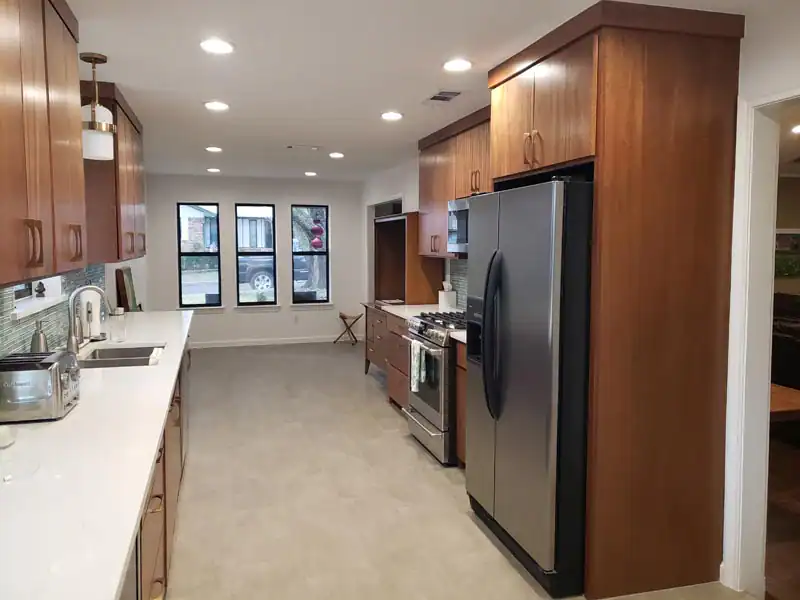
Modern kitchen with wood cabinets, stainless steel appliances, white countertops, light-colored tile floor.

Summary:

A kitchen remodel can be one of the smartest moves you make before listing — or one of the most expensive mistakes, depending on how you approach it. The DFW market has shifted, buyers have more leverage, and the gap between a permitted, professional remodel and a DIY attempt can show up directly on your closing statement. This post breaks down the real ROI numbers, the risks most homeowners don’t see coming, and what separates a kitchen upgrade that pays off from one that creates problems at the worst possible time.
Table of contents

You’re not remodeling because you love the process. You’re doing it because you want to sell, and you want to walk away with more than you put in. That’s a reasonable goal — and a kitchen remodel is one of the few renovations where the math can actually work in your favor. But “can” is doing a lot of work in that sentence. The outcome depends heavily on what you do, how it’s done, and whether it holds up when a buyer’s inspector starts poking around. Here’s what the data shows for homeowners in Tarrant County and the broader DFW area — and what it means for the decision you’re trying to make right now.

Kitchen Remodel ROI in DFW: What You Actually Get Back

The national headline number for a minor kitchen remodel is 113% ROI — meaning homeowners who make targeted, strategic updates can recoup more than they spend. That’s not a typo, and it’s not a best-case scenario. It’s what the data shows when the right upgrades are chosen for the right price point.

In the DFW market specifically, cabinet updates, quartz or granite countertops, and energy-efficient appliances consistently return 70 to 80 percent of their cost at resale. That’s the local number — not a national average stretched to fit. And it matters, because what sells in Southlake isn’t always what moves a home in Haltom City or Fort Worth.

The contrast that most homeowners miss is the gap between minor and major remodels. A full gut job — new layout, moved plumbing, custom everything — returns closer to 51% nationally. You can spend twice as much and walk away with less. Knowing where that line is, and staying on the right side of it, is often the difference between a remodel that performs and one that just looks expensive.

Smart Home Remodeling: Which Kitchen Upgrades Actually Move the Needle at Resale

Not every kitchen upgrade is created equal, and the ones that photograph well aren’t always the ones that appraise well. Smart home remodeling for resale means making decisions based on what buyers in your specific market actually respond to — not what looked good on a renovation show filmed in a different city.

In DFW, buyers consistently respond to three things: updated cabinets, stone countertops, and appliances that don’t look like they came with the house in 1994. These aren’t glamorous, but they’re the upgrades that move homes faster and justify asking prices. Quartz countertops alone can return up to 80% of their cost — and they hold up to the Texas heat and hard water that Tarrant County homeowners deal with every day, which matters when a buyer’s inspector is looking for signs of wear.

The design side of this matters more than most people expect. Neutral cabinet colors, timeless hardware, and materials that won’t look dated in three years are what attract the widest pool of buyers. Trendy choices feel exciting in the showroom and risky at the open house. We help homeowners avoid that trap through digital design visualization — you see the finished kitchen before a single cabinet is removed. That means you’re making decisions based on how it will look when buyers walk through, not guessing.

The other piece of smart remodeling is knowing when to stop. Over-improving for your neighborhood is a real mistake, and it’s one that’s easy to make when you’re emotionally invested in the project. A home in a $300,000 neighborhood doesn’t need a $60,000 kitchen. The goal is to bring your kitchen in line with buyer expectations for your price point — not to build the nicest kitchen on the block and hope the appraisal follows.

Why Unpermitted Kitchen Work Is a Resale Problem in Tarrant County

This is the part of the conversation that most people don’t have until it’s too late. In Tarrant County, any kitchen remodel that touches electrical, plumbing, or structural elements requires permits. That includes a lot of projects that homeowners assume are purely cosmetic — moving an outlet for a new appliance, updating a gas line for a range, adding recessed lighting. These aren’t optional permits. They’re required, and they exist because inspectors are trained to look for exactly this kind of work when a home goes on the market.

In DFW’s current buyer’s market, inspectors are thorough. Buyers have more choices than they did two or three years ago, and 66% of DFW properties sold below list price in early 2025. That means buyers are cautious, their inspectors are careful, and unpermitted work is a legitimate deal-killer. It can force you to tear out finished work, redo it with permits, and delay your closing — or it gives the buyer leverage to walk away or demand a significant price reduction.

If a contractor tells you a permit isn’t needed for the scope of work you’re describing, that’s a red flag worth taking seriously. Tarrant County’s permitting process varies by municipality — Fort Worth, Arlington, Haltom City, and Southlake each operate differently — and navigating that correctly requires someone who knows the local requirements, not someone who’s guessing. We pull permits on every project we touch. It’s not a selling point we added to a list; it’s how we’ve operated for 35 years because we’ve seen what happens when it’s skipped.

The older housing stock in many Tarrant County neighborhoods adds another layer to this. Homes built in the 1970s through 1990s — common throughout Fort Worth, Arlington, and Haltom City — often have electrical panels that weren’t designed for modern kitchen appliances. That’s a hidden cost DIYers frequently underestimate. You start with cabinet refacing and end up needing a panel upgrade to safely run a new refrigerator, dishwasher, and range on the same circuit. A licensed contractor catches that before it becomes a problem. A DIY project often doesn’t.

Home Quality Remodeling: Where DIY Falls Short for Resale

There’s a version of DIY that makes sense — painting a bedroom, swapping out light fixtures, refreshing hardware. A kitchen remodel for resale is a different category. The stakes are higher, the systems involved are more complex, and the margin for error is smaller when a buyer’s inspector is going to evaluate the work.

The data backs this up in a way that’s hard to ignore. Among homeowners who reported regrets about a remodel, 62% said the project cost more and took longer than expected. And 75% of those regretful remodelers had tackled kitchen remodeling specifically. That’s not a coincidence — kitchens involve more trades, more moving parts, and more decisions than almost any other room in the house.

Home quality remodeling isn’t just about the materials or the finished look. It’s about what happens after the job is done — whether the work is warrantied, whether it passes inspection, and whether it holds up over the years between your remodel and your closing date.

What Does It Actually Cost to DIY a Kitchen Remodel in DFW?

The appeal of DIY is obvious: skip the labor costs, pocket the savings, put that money toward your next home. It’s a reasonable instinct, and it works for some projects. But the actual cost of a DIY kitchen remodel is rarely what it looks like at the start.

Tool rental, material waste from the learning curve, do-overs on cuts that didn’t land right, trips back to the hardware store — these add up faster than most people expect. More importantly, the time cost is real. A professional crew can complete a cosmetic kitchen remodel in two to three weeks. A homeowner doing the same work on evenings and weekends is often looking at two to three months of living without a functional kitchen. That’s not a minor inconvenience when you’re trying to get a house ready to list.

Then there’s the quality gap that shows up at inspection. A buyer’s inspector in DFW knows what professional tile work looks like versus a first-timer’s attempt. They know how cabinet boxes should be mounted, how countertops should be supported, and what a properly finished backsplash looks like. Work that passes the eye test from across the kitchen doesn’t always pass a closer look. And in a buyer’s market where buyers are already looking for reasons to negotiate, giving them one is a costly mistake.

Kitchen remodels that add $13,500 to $25,000 or more to a home’s value don’t do that because the work was done cheaply. They do it because the work was done correctly, with materials that hold up, by people who know what DFW buyers are looking for. The savings from DIY can evaporate quickly if the result doesn’t move the needle on your sale price — or worse, if it creates a problem that has to be disclosed or remediated before closing.

What to Look for in a Renovation Expert Before You Sign Anything

The renovation industry has a well-documented problem: contractors who take deposits and disappear, subcontractors who do inconsistent work, verbal estimates that balloon into something unrecognizable by the end. We started because too many Tarrant County homeowners had experienced exactly that. So when you’re evaluating who to hire for a kitchen remodel for resale, the things that matter most aren’t always the things that show up in a sales pitch.

A fixed-price written estimate is one of the clearest signals of a contractor who operates with integrity. Not a ballpark, not an estimate that’s “subject to change” — a written number that is your final price unless you change the scope. That matters enormously for resale planning, because you need to know your cost going in to calculate whether the ROI makes sense for your situation.

Permits are non-negotiable, and any renovation expert worth hiring will tell you the same. If a contractor is hesitant about pulling permits, that’s information. In Tarrant County, where the permitting process varies by city, you want someone who knows Fort Worth’s requirements from Arlington’s and can navigate that without making it your problem to manage.

The subcontractor question matters more than most homeowners realize. When multiple subcontractors touch a project, accountability gets diffuse. If something goes wrong, nobody is quite sure whose responsibility it is. We use a fully in-house licensed crew — the same team from demolition to final walkthrough — because that’s the only way to stand behind the work with a written warranty that actually means something. That warranty is what protects you between the day the remodel is finished and the day the buyer’s inspector shows up.

Finally, look for local references and verifiable reviews. A contractor who has been working in Tarrant County for decades has a track record you can check. Ask for it. The DFW market is specific — the materials that hold up here, the finishes that appeal to buyers here, the building codes that apply here — and experience in this market is not interchangeable with experience somewhere else.

Is a Kitchen Remodel Worth It Before Selling in DFW Right Now?

In the DFW market of 2025, the answer for most homeowners is yes — with the right scope, the right upgrades, and the right execution. A dated kitchen is no longer a neutral factor when buyers have more inventory to choose from than they did a year ago. It’s a negotiating chip, and buyers in Tarrant County are using it.

The math works when you make strategic choices: targeted upgrades over full gut jobs, permitted work that passes inspection, materials that hold up to Texas conditions, and finishes that appeal to the broadest pool of buyers rather than your personal taste. That’s where the 70 to 80 percent DFW resale return comes from — not from spending the most, but from spending it correctly.

If you’re weighing your options and want a straight answer about what makes sense for your home and your timeline, reach out to us. We’ve been having that conversation with Tarrant County homeowners since 1990. We’ll give you a real picture of what’s worth doing — and what isn’t.
Share:

Summary:

A kitchen remodel can be one of the smartest moves you make before listing — or one of the most expensive mistakes, depending on how you approach it. The DFW market has shifted, buyers have more leverage, and the gap between a permitted, professional remodel and a DIY attempt can show up directly on your closing statement. This post breaks down the real ROI numbers, the risks most homeowners don’t see coming, and what separates a kitchen upgrade that pays off from one that creates problems at the worst possible time.
Table of contents

You’re not remodeling because you love the process. You’re doing it because you want to sell, and you want to walk away with more than you put in. That’s a reasonable goal — and a kitchen remodel is one of the few renovations where the math can actually work in your favor. But “can” is doing a lot of work in that sentence. The outcome depends heavily on what you do, how it’s done, and whether it holds up when a buyer’s inspector starts poking around. Here’s what the data shows for homeowners in Tarrant County and the broader DFW area — and what it means for the decision you’re trying to make right now.

Kitchen Remodel ROI in DFW: What You Actually Get Back

The national headline number for a minor kitchen remodel is 113% ROI — meaning homeowners who make targeted, strategic updates can recoup more than they spend. That’s not a typo, and it’s not a best-case scenario. It’s what the data shows when the right upgrades are chosen for the right price point.

In the DFW market specifically, cabinet updates, quartz or granite countertops, and energy-efficient appliances consistently return 70 to 80 percent of their cost at resale. That’s the local number — not a national average stretched to fit. And it matters, because what sells in Southlake isn’t always what moves a home in Haltom City or Fort Worth.

The contrast that most homeowners miss is the gap between minor and major remodels. A full gut job — new layout, moved plumbing, custom everything — returns closer to 51% nationally. You can spend twice as much and walk away with less. Knowing where that line is, and staying on the right side of it, is often the difference between a remodel that performs and one that just looks expensive.

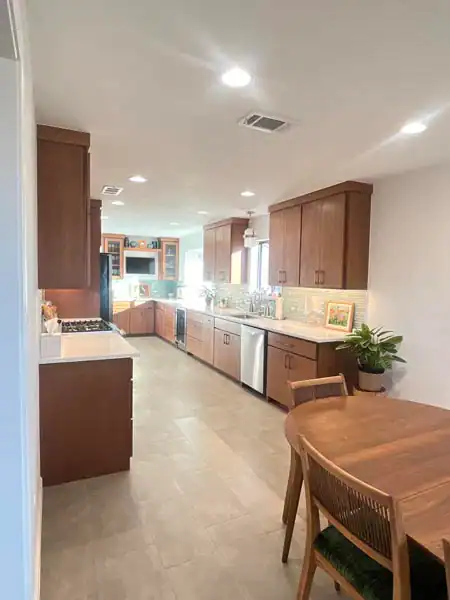
A modern kitchen with wooden cabinets, stainless steel appliances, light tile flooring, a round dining table with chairs.

Smart Home Remodeling: Which Kitchen Upgrades Actually Move the Needle at Resale

Not every kitchen upgrade is created equal, and the ones that photograph well aren’t always the ones that appraise well. Smart home remodeling for resale means making decisions based on what buyers in your specific market actually respond to — not what looked good on a renovation show filmed in a different city.

In DFW, buyers consistently respond to three things: updated cabinets, stone countertops, and appliances that don’t look like they came with the house in 1994. These aren’t glamorous, but they’re the upgrades that move homes faster and justify asking prices. Quartz countertops alone can return up to 80% of their cost — and they hold up to the Texas heat and hard water that Tarrant County homeowners deal with every day, which matters when a buyer’s inspector is looking for signs of wear.

The design side of this matters more than most people expect. Neutral cabinet colors, timeless hardware, and materials that won’t look dated in three years are what attract the widest pool of buyers. Trendy choices feel exciting in the showroom and risky at the open house. We help homeowners avoid that trap through digital design visualization — you see the finished kitchen before a single cabinet is removed. That means you’re making decisions based on how it will look when buyers walk through, not guessing.

The other piece of smart remodeling is knowing when to stop. Over-improving for your neighborhood is a real mistake, and it’s one that’s easy to make when you’re emotionally invested in the project. A home in a $300,000 neighborhood doesn’t need a $60,000 kitchen. The goal is to bring your kitchen in line with buyer expectations for your price point — not to build the nicest kitchen on the block and hope the appraisal follows.

Why Unpermitted Kitchen Work Is a Resale Problem in Tarrant County

This is the part of the conversation that most people don’t have until it’s too late. In Tarrant County, any kitchen remodel that touches electrical, plumbing, or structural elements requires permits. That includes a lot of projects that homeowners assume are purely cosmetic — moving an outlet for a new appliance, updating a gas line for a range, adding recessed lighting. These aren’t optional permits. They’re required, and they exist because inspectors are trained to look for exactly this kind of work when a home goes on the market.

In DFW’s current buyer’s market, inspectors are thorough. Buyers have more choices than they did two or three years ago, and 66% of DFW properties sold below list price in early 2025. That means buyers are cautious, their inspectors are careful, and unpermitted work is a legitimate deal-killer. It can force you to tear out finished work, redo it with permits, and delay your closing — or it gives the buyer leverage to walk away or demand a significant price reduction.

If a contractor tells you a permit isn’t needed for the scope of work you’re describing, that’s a red flag worth taking seriously. Tarrant County’s permitting process varies by municipality — Fort Worth, Arlington, Haltom City, and Southlake each operate differently — and navigating that correctly requires someone who knows the local requirements, not someone who’s guessing. We pull permits on every project we touch. It’s not a selling point we added to a list; it’s how we’ve operated for 35 years because we’ve seen what happens when it’s skipped.

The older housing stock in many Tarrant County neighborhoods adds another layer to this. Homes built in the 1970s through 1990s — common throughout Fort Worth, Arlington, and Haltom City — often have electrical panels that weren’t designed for modern kitchen appliances. That’s a hidden cost DIYers frequently underestimate. You start with cabinet refacing and end up needing a panel upgrade to safely run a new refrigerator, dishwasher, and range on the same circuit. A licensed contractor catches that before it becomes a problem. A DIY project often doesn’t.

Want live answers?

Connect with a A Plus Home Remodel expert for fast, friendly support.

Home Quality Remodeling: Where DIY Falls Short for Resale

There’s a version of DIY that makes sense — painting a bedroom, swapping out light fixtures, refreshing hardware. A kitchen remodel for resale is a different category. The stakes are higher, the systems involved are more complex, and the margin for error is smaller when a buyer’s inspector is going to evaluate the work.

The data backs this up in a way that’s hard to ignore. Among homeowners who reported regrets about a remodel, 62% said the project cost more and took longer than expected. And 75% of those regretful remodelers had tackled kitchen remodeling specifically. That’s not a coincidence — kitchens involve more trades, more moving parts, and more decisions than almost any other room in the house.

Home quality remodeling isn’t just about the materials or the finished look. It’s about what happens after the job is done — whether the work is warrantied, whether it passes inspection, and whether it holds up over the years between your remodel and your closing date.

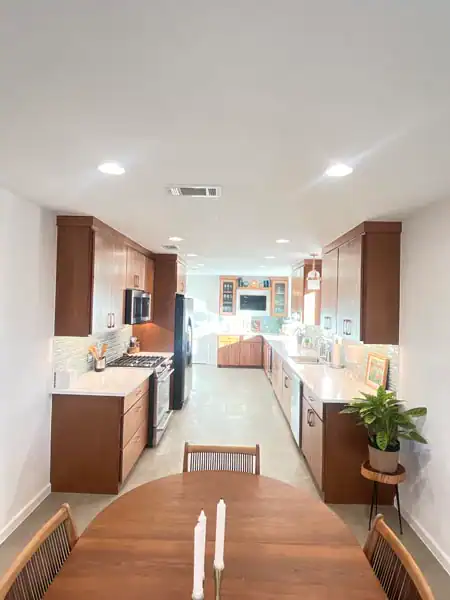
A kitchen with a table and chairs.

What Does It Actually Cost to DIY a Kitchen Remodel in DFW?

The appeal of DIY is obvious: skip the labor costs, pocket the savings, put that money toward your next home. It’s a reasonable instinct, and it works for some projects. But the actual cost of a DIY kitchen remodel is rarely what it looks like at the start.

Tool rental, material waste from the learning curve, do-overs on cuts that didn’t land right, trips back to the hardware store — these add up faster than most people expect. More importantly, the time cost is real. A professional crew can complete a cosmetic kitchen remodel in two to three weeks. A homeowner doing the same work on evenings and weekends is often looking at two to three months of living without a functional kitchen. That’s not a minor inconvenience when you’re trying to get a house ready to list.

Then there’s the quality gap that shows up at inspection. A buyer’s inspector in DFW knows what professional tile work looks like versus a first-timer’s attempt. They know how cabinet boxes should be mounted, how countertops should be supported, and what a properly finished backsplash looks like. Work that passes the eye test from across the kitchen doesn’t always pass a closer look. And in a buyer’s market where buyers are already looking for reasons to negotiate, giving them one is a costly mistake.

Kitchen remodels that add $13,500 to $25,000 or more to a home’s value don’t do that because the work was done cheaply. They do it because the work was done correctly, with materials that hold up, by people who know what DFW buyers are looking for. The savings from DIY can evaporate quickly if the result doesn’t move the needle on your sale price — or worse, if it creates a problem that has to be disclosed or remediated before closing.

What to Look for in a Renovation Expert Before You Sign Anything

The renovation industry has a well-documented problem: contractors who take deposits and disappear, subcontractors who do inconsistent work, verbal estimates that balloon into something unrecognizable by the end. We started because too many Tarrant County homeowners had experienced exactly that. So when you’re evaluating who to hire for a kitchen remodel for resale, the things that matter most aren’t always the things that show up in a sales pitch.

A fixed-price written estimate is one of the clearest signals of a contractor who operates with integrity. Not a ballpark, not an estimate that’s “subject to change” — a written number that is your final price unless you change the scope. That matters enormously for resale planning, because you need to know your cost going in to calculate whether the ROI makes sense for your situation.

Permits are non-negotiable, and any renovation expert worth hiring will tell you the same. If a contractor is hesitant about pulling permits, that’s information. In Tarrant County, where the permitting process varies by city, you want someone who knows Fort Worth’s requirements from Arlington’s and can navigate that without making it your problem to manage.

The subcontractor question matters more than most homeowners realize. When multiple subcontractors touch a project, accountability gets diffuse. If something goes wrong, nobody is quite sure whose responsibility it is. We use a fully in-house licensed crew — the same team from demolition to final walkthrough — because that’s the only way to stand behind the work with a written warranty that actually means something. That warranty is what protects you between the day the remodel is finished and the day the buyer’s inspector shows up.

Finally, look for local references and verifiable reviews. A contractor who has been working in Tarrant County for decades has a track record you can check. Ask for it. The DFW market is specific — the materials that hold up here, the finishes that appeal to buyers here, the building codes that apply here — and experience in this market is not interchangeable with experience somewhere else.

Is a Kitchen Remodel Worth It Before Selling in DFW Right Now?

In the DFW market of 2025, the answer for most homeowners is yes — with the right scope, the right upgrades, and the right execution. A dated kitchen is no longer a neutral factor when buyers have more inventory to choose from than they did a year ago. It’s a negotiating chip, and buyers in Tarrant County are using it.

The math works when you make strategic choices: targeted upgrades over full gut jobs, permitted work that passes inspection, materials that hold up to Texas conditions, and finishes that appeal to the broadest pool of buyers rather than your personal taste. That’s where the 70 to 80 percent DFW resale return comes from — not from spending the most, but from spending it correctly.

If you’re weighing your options and want a straight answer about what makes sense for your home and your timeline, reach out to us. We’ve been having that conversation with Tarrant County homeowners since 1990. We’ll give you a real picture of what’s worth doing — and what isn’t.

Article details:

Share: